By Charmaine Mercer
I have many childhood memories of me pulling a red wagon full of random items — things I collected throughout daily journeys around the house and outside. Dolls, stuffed animals, books, my sister’s favorite toys. I used to haul a lot!
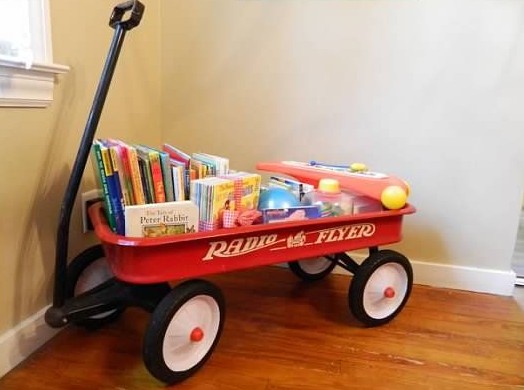
My red, metal Flyer wagon had white letters and a long black handle, strongly affixed and sturdy enough for whatever my imagination could acquire. I absolutely loved my wagon and everything in it. I also had no idea what was at the bottom, because I never emptied it or threw anything away. As you might imagine, there were times when it was simply too heavy to pull. Over time, I collected too much and failed to organize or discard what I no longer needed.
As an adult, the red wagon became a metaphor I return to often. I ask clients and colleagues: What are you carrying in your red wagon? What from your past are you hauling that no longer serves you? Each of us pulls a wagon filled with the lessons and messages we’ve acquired throughout our lives. The real question is: how do you ensure the items in your wagon continue serving you?
I remember one day when the wagon was simply too heavy to move, and I started to cry. My father looked at me, removed a huge rock I had found and placed it on the ground, and proudly announced, “Now you can pull it!” I cried even louder. I wanted everything in the wagon. I wanted to pull the wagon with everything in it.
Being the young father he was — with limited patience — he put the rock back and said, “O-K. But you won’t be able to pull it.” He was right. I couldn’t move it. I was even more frustrated and cried even louder.
It was my mother who got to the bottom of it. She was no-nonsense, she said, “You better decide what you want to get rid of — and do it fast — and stop all that crying.”
I am sure her tone had something to do with what happened next. I started moving things around and identifying what I could let go. I questioned if I needed the rock, and other items, including my sister’s favorite toy, that I did not like. I dumped the rock, returned my sister’s toy, and suddenly the wagon was easy to move.
That moment was a preview of something I would experience four decades later. In 2018 — before I was introduced to the Enneagram by my coach Joel Yanowitz — I found myself wondering what was inside my wagon, this time in the workplace.
I was struggling to be understood as the collaborative, laid-back introvert and former DC policy wonk that I am. For two years, I had genuinely tried to help the team succeed. I gladly assumed the lead on refreshing the team’s strategy, identifying the lead consultant, establishing a close working partnership — we called ourselves the GSD crew — engaging my network of grantees and partners on the approaching changes, and ultimately securing the board’s approval of a new strategy that centered those furthest from opportunity.
I truly thought I was being helpful. The team experienced me entirely differently.
Without words, their actions signaled something wasn’t quite right. Conversations felt strained. Efforts to engage them on the strategy felt like pulling the wagon with the heavy rock. I could feel something but could not name what it was. I kept pulling harder on the handle and wondering why the wagon wouldn’t move.
The day I reviewed my Enneagram report, I felt like I had been read. I’m sure I clutched my imaginary pearls — it was that resonant. The framing and guidance the tool and my coach offered positioned me to see things newly and differently. I could identify moments where my choices and actions may have reinforced my peers’ perception that I was exercising positional authority or asserting greater expertise. I could also appreciate the difficulty a colleague might experience when holding an opposing view with someone they respect and care about.
This new insight enabled me to choose which behaviors to lean into and which ones to turn down— and just like the day I shifted things around in my red wagon, I could move with greater ease.
Effective leadership requires the willingness to look inside the wagon — to examine what we are carrying, understand how we came to carry it, and make intentional choices about what we bring to any situation.
Some of what we carry are authentic assets: instinctual wisdom, lived experience, and values learned from challenges. Some of the other contents, such as being confrontational, aggressive, or a perfectionist, may have once served us well but now make the wagon nearly immobile.
Taking time for this type of reflection is important, and often avoided by leaders, for many reasons. It is uncomfortable. It requires mourning the loss of comfortable habits that no longer serve us. And most important — it requires slowing down. But the leaders who are willing to do it — they move and lead differently.
So, I will ask you what I ask my clients and colleagues: What’s inside your little red wagon? And more importantly — what do you need to put down so you can move forward with greater ease? Click the link below and let me know.
© 2025 Wit and Wisdom Collaborative | All Rights Reserved | Website and Branding by Stephanie Cariker